The Resource Gap nobody's talking about (and why it's keeping wāhine Māori small)

A few years ago, I was on a call with my accountant - the third accountant I’d had in five years of business. He was meant to be showing me how to use streams in Xero, but we were stuck because I was doing a not-so-great job of trying to explain to him who Te Puni Kōkiri was and why I was receiving a significant amount of money from them.
It was sucking the energy out of me, trying to explain that they were the Ministry for Māori Development, and I had a contract for a funded initiative with them. The worst part, though, was that I knew if he didn’t know who Te Puni Kōkiri was, he wouldn’t understand my business model, and I had little trust in him being able to give me the best possible advice. So I was on my own. Again.
In 2023, we ran our six-month intensive business programme for wāhine Māori business owners, and I remember in our first wānanga, nearly every single person saying - I don’t know where to go for help. Most were early-established pakihi, and they were relying on Google searches and online recommendations for support and services that may or may not have helped them.
I kept hearing the same story - either they didn’t know where to go, or the support they did manage to access just wasn’t what they needed, or they didn’t understand their pakihi. And it turned out that this was way more common than we’d have liked to hope for.
Why This Keeps Happening
So why does this keep happening?
Why are capable, driven wāhine Māori struggling to access basic business support?
My unpopular opinion is that there are several reasons why this is a way too common experience for early-established pakihi owners, and even more so for wāhine.
Mainstream/generic advice doesn’t understand the Māori context
Aotearoa doesn’t lack support and services in general; there are many mainstream and generic advice options available, and some are highly rated in our book, but many are not. And the number one reason is, they just don’t understand us.
When you have to spend the first 30 minutes of a meeting with your accountant, lawyer, supplier, or manufacturer just explaining the Māori context of what you do, for who, and why, you end up with low levels of trust, faith and rapport.
Props must go to those mainstream services that have done the mahi to understand the Māori context and are well-positioned to truly serve and support our people too - we appreciate you!
We operate in silos
Believe it or not, even though we are very much a collective people, we still seem to operate in silos, or small groups and communities. And it doesn’t just hinder access to support and services, but also access to collaboration and connection. Whether it’s location-based boundaries, industry, stage, or status-based boundaries.
The result? We end up with exclusivity, or at least a reputation for exclusivity, which makes it all the more harder, overwhelming, and intimidating for the fresh new pakihi down the road who’s just looking for others to connect with and to gain some advice.
We still prioritise the big boys’ club - even in Te Ao Māori
Speaking of silos and exclusivity.. That’s right - we called it out (we did say unpopular opinions!), even in Te Ao Māori, the big boys' club, or the old boys' club, or just the boys' club exists.
Te Ao Māori is not immune to the inequities of gender, and on the whole, tāne are still more likely to access what they need and receive what they’re worth, more than wāhine. You only need to read Balance Destroyed by Ani Mikaere to understand how the status of mana wāhine has shifted through colonisation, and the business world is a platform for this imbalance.
Examples look like prioritising procurement support to tāne-dominated industries, such as construction and trades, over wāhine-dominated industries, such as care and personal services. It looks like tāne being more commonly represented as speakers, award-winners, and examples of success.
What This Actually Costs
Typically, you can expect 20% of businesses to fail in their first year, and 50% to have failed by their fifth year. If that’s the general statistics we’re dealing with, the learning curve is pretty steep to be on the right side of that 50%. Businesses and business owners who are well-supported are more likely to be ones that are still in business after five years. And for wāhine Māori business owners navigating that resource gap? Those odds get worse.
So what does that say for wāhine Māori business owners, if we can’t even find where to get support in the first place? The odds are stacked against us even more. The number of epic business ideas I’ve seen over the years that have never made it past their first few customers is gutwrenching.
Not just because the business fails. Not just because it was a cool idea.
But because business represents so much more than just pūtea for the founder.
How would it be if your legacy or your impact never came to be?
Imagine the world missing out on what you have to offer, not because it wasn’t amazing, but because you didn’t have access to the right support and services. That’s just not a sacrifice we want to take, and it’s one of the reasons I get up every day and pour into Te Kāinga Wāhine - because your pakihi, and you deserve to thrive.
What Becomes Possible
So let’s flip the script. Imagine being a wahine Māori pakihi owner with access to everything you need to succeed - the systems, support, visibility, and pūtea to give you the best possible head start. You can’t ask for much more, really, right?
The statistics on Māori women in business speak for themselves:
Nearly 40% of Māori-owned businesses have a wahine Māori owner;
Wāhine Māori-owned businesses are more likely to employ Māori;
Wāhine Māori contribute $ 12.5 billion to Te Ōhanga Māori (the Māori economy), which includes $ 6.6 billion of unpaid work.
We’re good for business, and business is good for us when we have the support we need. Te Kāinga Wāhine exists to ensure that support is accessible and inclusive for all wāhine who choose to enter the pakihi world.
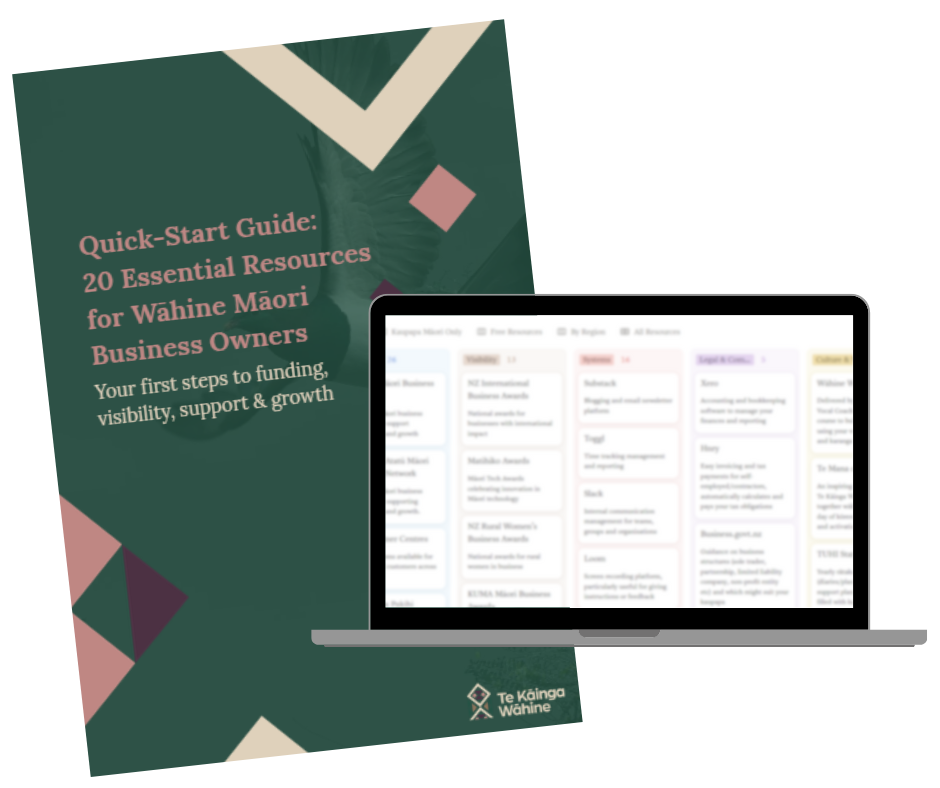
Changing this system entirely? That's long-term mahi. But there are things we can do right now to shift the odds - starting with ensuring wāhine Māori know exactly where to access the support that actually exists. That’s why we developed the Free Guide + Database of 90+ Resources for Wāhine Māori Business Owners.
90+ Resources to Close the Gap
Having worked with pakihi Māori for years and collaborated with various organisations geared towards supporting pakihi Māori, we’ve compiled a list of resources for Māori businesses across the motu. We’ve compiled networks (both big and small), funding opportunities, directories, awards, learning and development resources, coaching and mentoring services, and then filtered them to identify the best options specifically for wāhine Māori.
We’ve even included our favourite mainstream systems and support because we know sometimes what we need exists outside of Te Ao Māori, and we’re not afraid to bring that resource in when we need to, as long as it’s helping, not holding us back.
It’s not the golden ticket to Wonka’s factory, and it’s nothing like a magic pill, but what it will do is show you just the beginning of what support is possible for you and your pakihi. It’ll show you that you’re certainly not alone, you can get support from others who understand you, and you can be celebrated for being a wahine Māori business owner.
And don’t forget, if you find them useful (or this blog post!), please share with another wahine you know who might be looking for support - because we’re stronger when we support one another!